I got one of those simple tips recently that feels almost too easy, and that’s exactly why I couldn’t wait to share it, because the best home tricks are usually the ones that don’t require a new product, a new system, or a whole weekend.
They just solve one irritating problem in a way that makes you wonder why you didn’t think of it sooner.
It happened while I was watching HGTV, during one of those segments where the host walks through a home and points out the kinds of organized details that make you feel both inspired and slightly called out.
The house they toured was the kind of place where everything had a home, nothing looked overstuffed, and the closets weren’t stuffed with “maybe someday” clothes.
Everything was hung neatly, and the whole closet looked calm, like it belonged to a person who doesn’t spend mornings fighting with a pile of fabric.

Then I noticed something I had never seen before, and I leaned closer to the screen like it was a mystery.
On the hangers, right where the hanger bends down into that shoulder slope, there was a fuzzy wrap. Not bulky. Not messy. Just enough texture to keep clothes from sliding off.
And the host explained it in one sentence: she uses pipe cleaners.
I actually laughed, because pipe cleaners are something I associate with crafts and childhood, not with a tidy closet that looks like a magazine. Still, the more I looked, the more obvious it became.
Slippery hangers and slippery fabrics are a constant tiny frustration, especially for camisoles, silky blouses, wide-neck sweaters, and anything that seems to slide off the second you close the closet door.
This was a low-cost, low-effort fix that creates friction in exactly the right spot.
The Problem This Trick Solves
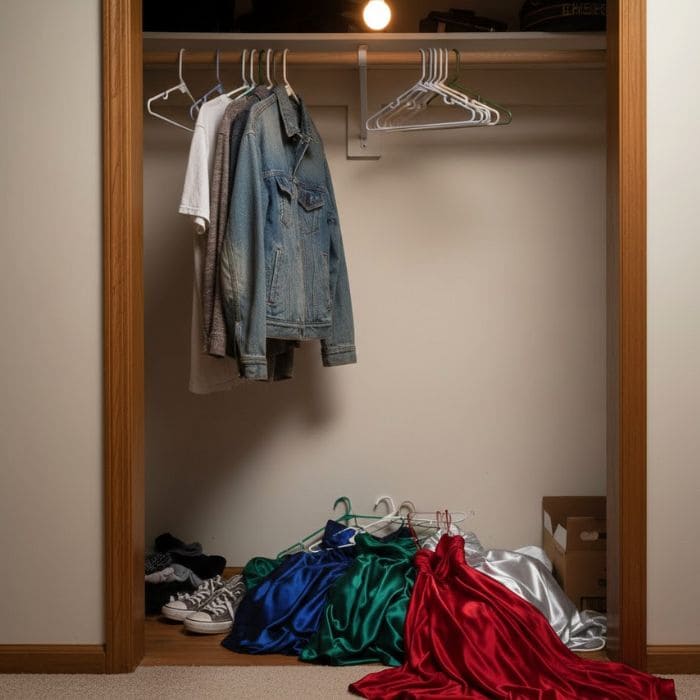
Most of us have at least a few pieces of clothing that refuse to stay on a hanger. You hang them carefully. You turn away. Later you open the closet and find the top on the floor like it gave up.
This usually happens for three reasons:
- First, many hangers are too smooth. Plastic hangers and some metal hangers don’t provide grip, so fabrics slide.
- Second, some clothing is naturally slippery. Satin, rayon, silk blends, even some athletic materials behave like they want to escape.
- Third, certain cuts don’t sit well on standard hanger shoulders. Wide necklines, off-shoulder styles, spaghetti straps, and loose knits slide because there’s nothing to catch them.
Therefore, a pipe cleaner wrap fixes this by adding a soft, textured surface right where the garment needs friction.
The Pipe Cleaner Hanger Trick: What You Do
This is the basic method, and it’s almost silly how quick it is. Take one pipe cleaner and wrap it around the bent shoulder section of the hanger, the area where the hanger slopes down and the garment usually slips.
You don’t need to wrap the entire hanger. You only need to cover the two shoulder slopes, left and right.
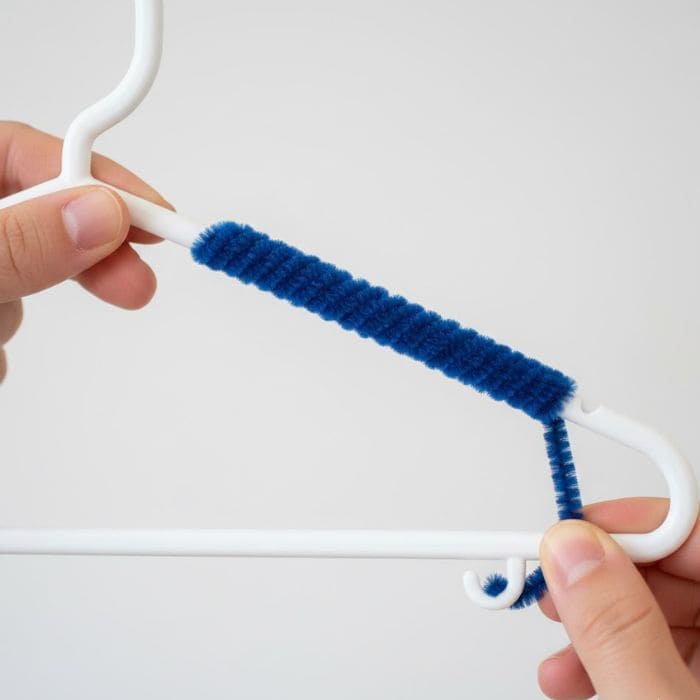
I like starting near the top curve and wrapping downward in even spirals, overlapping slightly so there are no gaps.
When I reach the end, I twist the pipe cleaner end tightly on the underside of the hanger so it’s hidden and won’t snag fabric. Then I repeat on the other side.
For a standard adult hanger, one pipe cleaner per side is usually enough, but if the hanger is thick or the garment is especially slippery, you can use two per side for more grip.
Once you get the hang of it, it takes about one minute per hanger, and you don’t need tools.
Which Clothes Benefit Most
This trick is perfect for:
- Silky blouses that slide off plastic hangers.
- Spaghetti strap camisoles.
- Wide-neck sweaters that fall forward.
- Slippery dresses that shift overnight.
- Lightweight jackets that don’t sit well on thin hangers.
It’s also surprisingly helpful for kids’ clothes, because smaller items slide even more easily.
The Most Important Part: Choosing the Right Pipe Cleaner
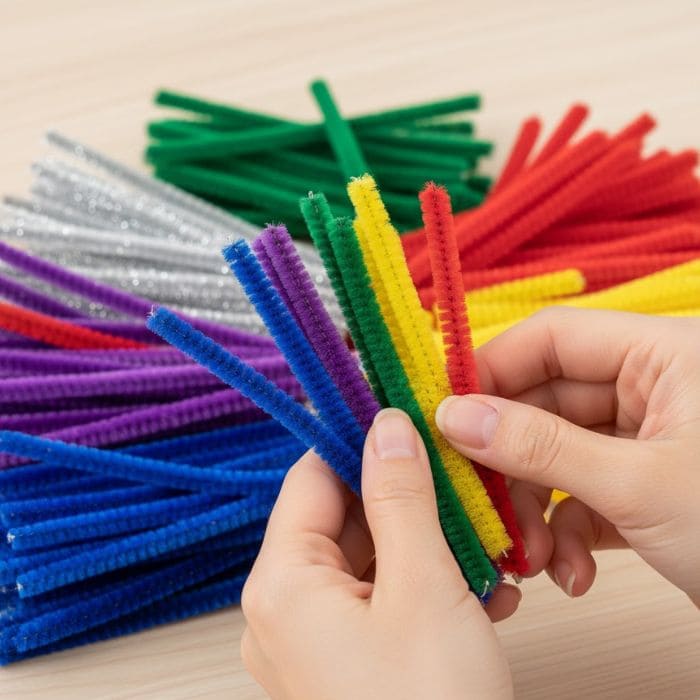
I want to pause here because this is the part that matters, and it’s why I’m writing this post with a warning.
Pipe cleaners are not all the same quality, and some online shops sell ones that look fine in photos but shed fuzz, feel scratchy, or have thin wire that bends too easily and loses shape.
If you wrap a low-quality pipe cleaner, it can unravel, shed fibers, or snag delicate fabric, which defeats the whole point.
Here’s what to look for.
1. Choose chenille stems with dense fibers
The best pipe cleaners for this are the craft type often labeled “chenille stems.” You want ones that feel plush and dense, not sparse or wiry.
A quick test: if you can easily see lots of wire through the fibers, it’s too thin.
2. Pick a medium thickness
For hangers, I prefer a standard thickness, not the ultra-thin ones that feel like they’re made to be cheap. Medium thickness holds shape and adds enough texture to grip.
If the pipe cleaner feels flimsy in your hand, it will not hold up long-term on a hanger.
3. Go for color that blends into your closet
This is not necessary, but it makes the closet look neat. Choose white, black, beige, or gray depending on your hangers and your closet vibe.
If you want it to look invisible, match the pipe cleaner color to the hanger.
4. Avoid scratchy metallic or glitter styles
Metallic or glitter pipe cleaners can be stiff and sometimes abrasive, and I don’t love them near delicate fabrics. They can also shed glitter, which is not the vibe I want in my closet.
5. Look for low-shed fibers
If you rub the pipe cleaner between your fingers and it sheds fuzz immediately, skip it. You want fibers that stay put.
How Many Hangers You Actually Need to Wrap
You don’t need to wrap every hanger in your closet. You only need to wrap the ones that hold problem items.
I’d start with five to ten hangers, the ones you use for slippery tops and wide necklines, then expand only if you love the result.
If you wrap everything, it can become unnecessary effort and it can make the closet feel visually busy.