
I realized I’ve talked about paint colors, pantry shelves, and all the small projects that keep a house moving forward, but I’ve never properly introduced one of the most alive objects in my living room, which is our antique clock, the one that keeps ticking even when the house is quiet and it’s only me and my dog stretched out in a sun patch.
It’s the kind of piece you stop noticing when you live with it every day, and then one evening you catch the light on the face and remember, oh right, this isn’t just decor, this is a thing with history, and it has been keeping time far longer than I have been keeping track of my own days.
My husband and I bought it years ago at SoWa Vintage Market in Boston’s South End, the kind of Sunday outing that used to feel easy for us, slow wandering, no pressure, just the hope that something would catch our eye and feel like it belonged to the home we were building together.
SoWa Vintage Market is located in Harrison Ave and it’s known for antiques, collectibles, and one-of-a-kind vintage finds, and it runs every Sunday year-round, rain or shine, which is part of why we loved it, because it made ordinary Sundays feel like they had a little magic built into them.
What the Clock Looks Like, Shape, Color, and the Details That Make It Feel Old in a Good Way
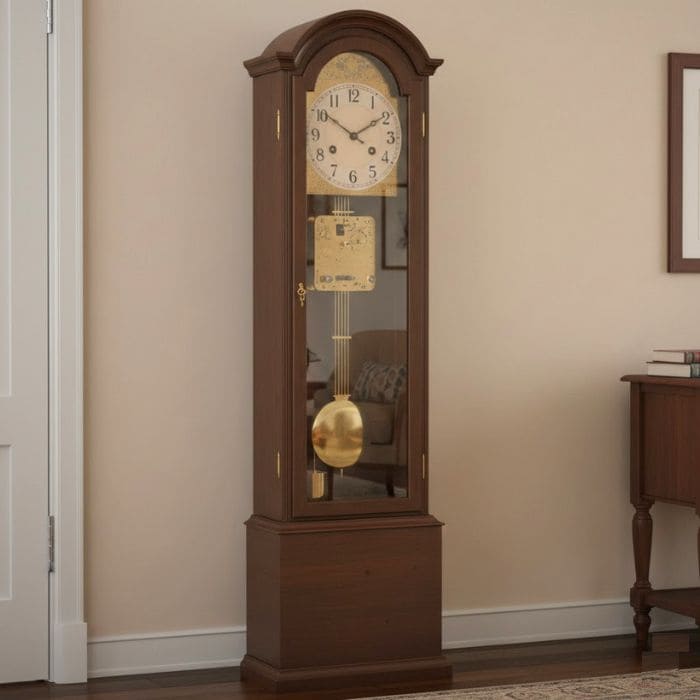
Our clock is a tall, narrow piece with a softly arched top, and it’s built from dark wood that reads like walnut or stained oak, not glossy in a modern way, but warm and mellow, like the finish has been handled and dusted and lived with for decades.
The front has a glass panel that lets you see the movement area, and in certain light you can catch a faint reflection of the room inside it, which sounds like a small thing, but it makes the clock feel like it belongs to the space rather than sitting on top of it.
The clock face is one of my favorite parts because it isn’t bright-white new, it’s more of a soft cream that looks gently aged, and it has dark numerals that are still easy to read from across the room, which matters because I’m not interested in pretty but useless, especially in a piece that takes up real visual space.
The hands are slim and darker toned, and the hardware, the little hinge and latch details, are a muted metal that doesn’t shout, which is exactly what I like about antique pieces, they feel confident without trying to sparkle.
As for features, ours is the kind that gives you a steady tick you can hear in the evening when the TV is off, and it has a subtle chime that can be softened depending on how you set it up, which I’ll talk about later, because I have learned the hard way that charming sounds are only charming until you’re trying to fall asleep.
The Moment We Found It at SoWa
We found it in a booth tucked between framed prints and stacks of old books, and I noticed it because it looked calm, like it had spent years doing exactly one job and doing it reliably, which is an energy I’ve always been drawn to.
My husband’s first reaction was to test the practical details, the way he always did, checking the door, looking at the face, asking the vendor questions that made me roll my eyes affectionately, and then quietly admitting he liked it too.
SoWa has a particular atmosphere on Sundays, partly because it’s a weekly vintage market and partly because everyone there seems to be on the same mission, to find one good thing that feels personal, not mass-produced.
What I Know About Its Origin
When people ask where an antique clock is from, they usually mean two things, where it was made and roughly when, and the truth is you can often get surprisingly close without becoming an expert if you look for the right clues.
The first clue is the maker’s mark or label, which is often inside the door, on the back panel, or stamped onto the movement itself, so if you have an old clock and you’ve never looked behind it, that’s the easiest place to start.
The second clue is how it’s powered, because a key-wound mechanical movement often points to a different era than a modern battery insert, and you can usually tell by the presence of winding holes on the clock face and the feel of the mechanism when it runs.
The vendor told us ours was likely early 1900s to mid-1900s, which is a broad range, but it matches the style and materials, and it also matches what you often see in New England vintage markets, pieces that were built to last, passed through homes, then eventually resold when someone downsized or moved.
Where It Lives in My Living Room
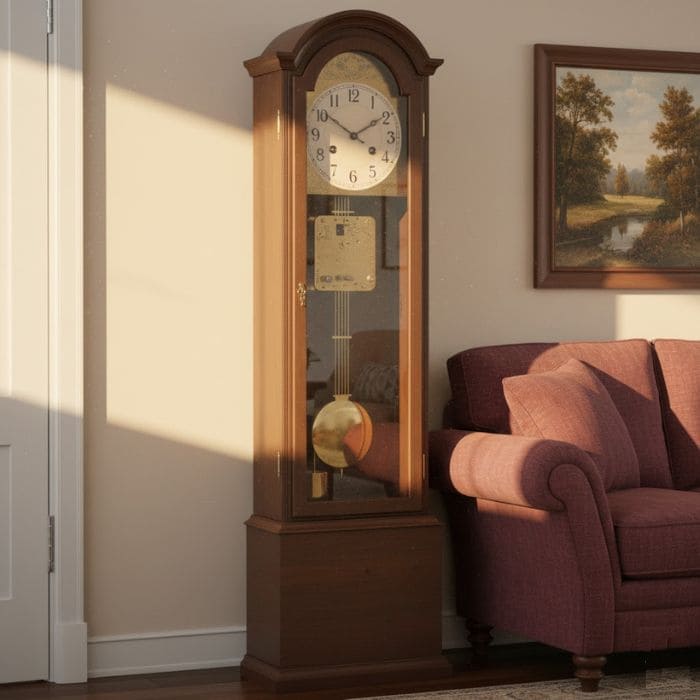
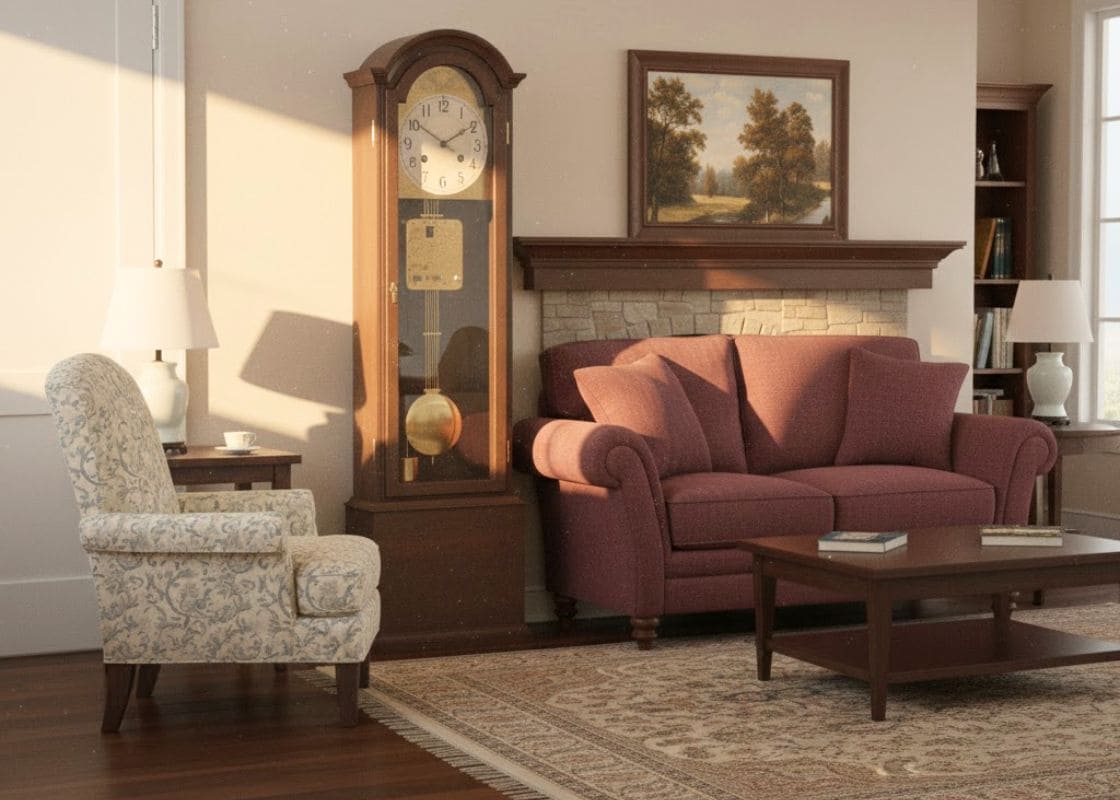
The clock lives slightly off-center in my living room, not because I’m trying to style it like a magazine, but because antique pieces look best when they feel integrated, like they belong to the rhythm of the room.
I keep it where it catches daylight softly without glare on the face, and where the ticking reads as comforting rather than sharp, because sound changes depending on what wall it’s near and what surfaces surround it.
The most important practical detail is stability, because antique clocks behave better when they’re level, and even a small tilt can affect how consistently they keep time, especially if there’s a pendulum involved.
My simple hack is keeping a tiny level nearby and checking it after vacuuming or moving furniture, because it saves me from blaming the clock for what is really my slightly uneven floor.
How I Care for It, Without Turning It Into a Stressful Project
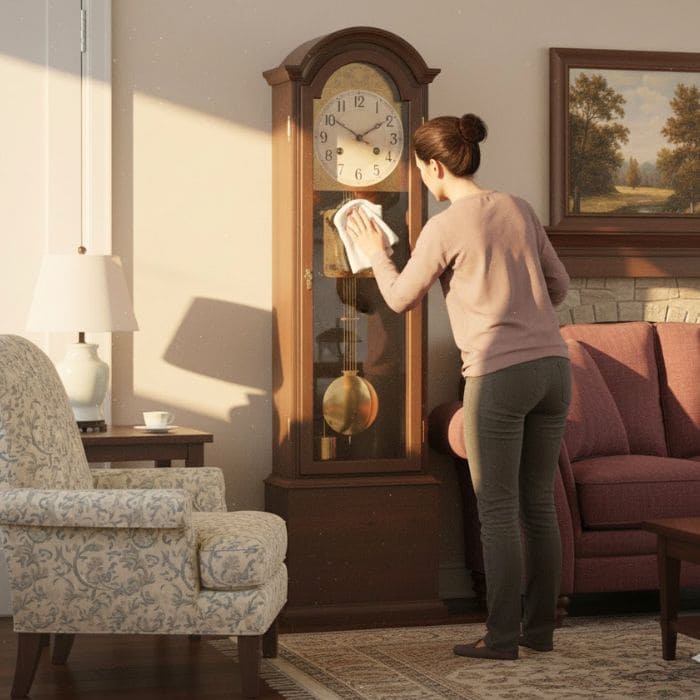
I don’t treat the clock like a museum piece, but I do treat it like something worth keeping healthy, because it has lasted this long for a reason.
I keep it away from direct heat sources and strong drafts, because old wood and mechanical parts respond to rapid temperature shifts and humidity changes, and the easiest way to make an antique piece grumpy is to park it next to a radiator or a vent that blasts hot air in winter.
I dust it gently, I avoid spraying cleaner directly onto the wood or glass, and when I do wipe it, I use a barely damp cloth and dry it right away, because moisture is one of the few things that can quietly damage old finishes over time.
If the clock ever starts running noticeably off, I don’t try to force fixes, because I’ve learned that delicate mechanisms deserve careful hands, and paying for a professional tune-up is less expensive than turning a small issue into a permanent one.
Why This Clock Feels Like an Anchor Now
I think the reason I’m finally sharing this story is because the clock is not just pretty, it’s steady, and steadiness matters to me more now than it did years ago.
The ticking fills the room in a way that feels grounding rather than lonely, and sometimes when I’m sitting with my dog in the evening, I catch myself listening to it and feeling something settle, like the house is gently reminding me that time keeps moving, and I’m still here inside it.