Someone comes over, we do the normal hello at the door, my dog does his quick inspection like he’s checking credentials, and then, once coats are off and the room settles, their eyes drift to the side table.
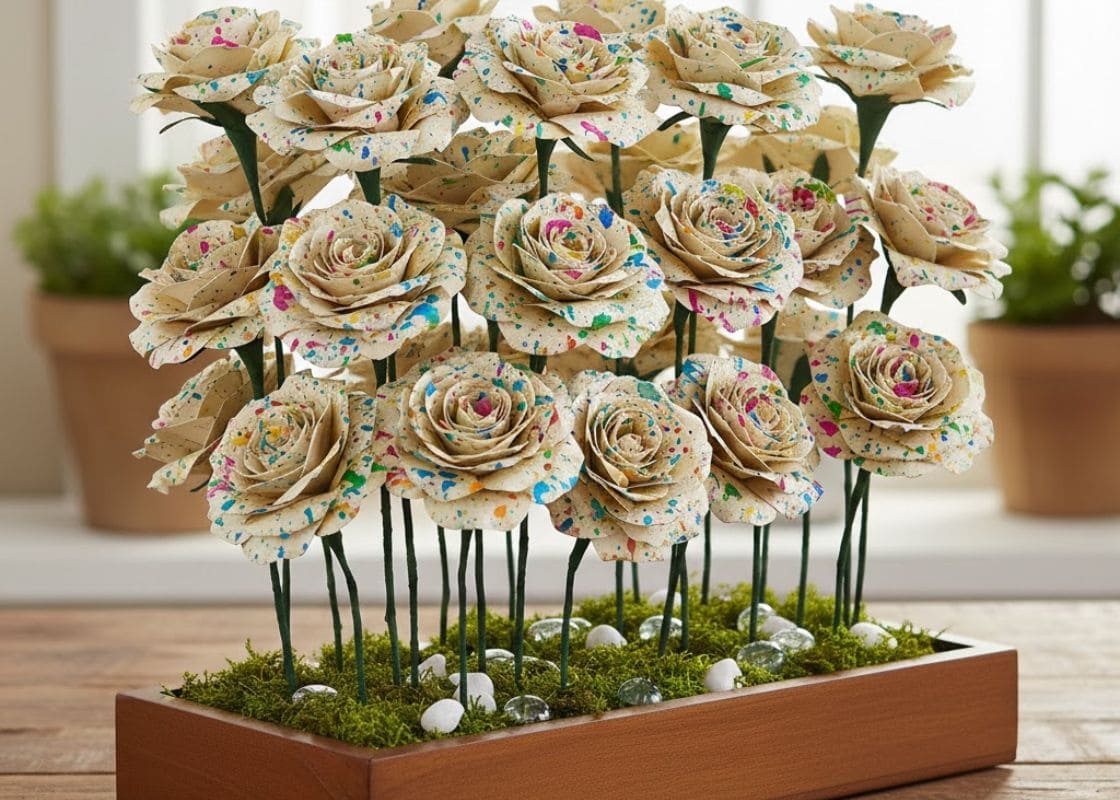
I keep a small tray there, nothing dramatic, just a cluster of roses that looks like it belongs in the house the way a good candle does, quietly, without shouting for attention.
And then they do what people always do with roses. They lean in. Not because they’re being nosy, but because roses pull you in, even when you’re trying to act casual.
Sometimes they’ll say, “Those are gorgeous,” and sometimes they’ll say, “Did you just get these?” and once, a friend said it like an accusation, “Mia… those can’t be real. They look too perfect.”
That is when I tell them the truth and watch their face change.
Why I Made Paper Roses in the First Place
I love real flowers, but real flowers in my house come with a little sadness attached, because they’re beautiful and then they’re gone, and on weeks when I already feel stretched thin, watching a bouquet fade feels like one more tiny thing I didn’t keep alive.
That sounds dramatic, but it’s true, and I’ve learned to pay attention to what makes my home feel soothing instead of slightly heavier.
So I wanted roses that stayed. I also wanted a project that didn’t require me to be on. Paper crafts are quiet work.
You can sit down, put on something comforting in the background, and just move your hands for a while. After my husband passed, I didn’t always know what to do with evenings, and projects like this gave the hours a shape.
What the Tray Looks Like, and Why It Works
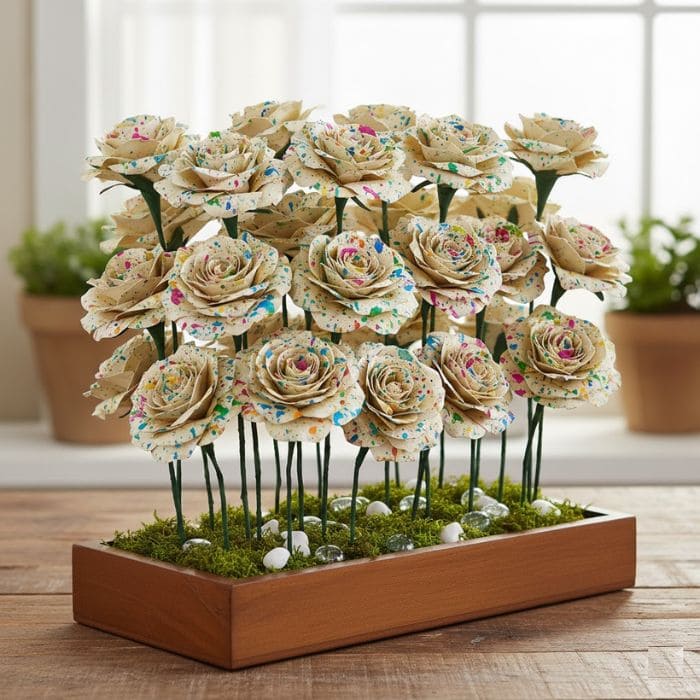
It’s a shallow tray, the kind you could easily use for candles or coasters, and the roses sit in it like they’ve been placed casually after someone carried them home.
That casual placement is important, because perfectly arranged flowers can start looking fake, while slightly imperfect placement reads as real life.
The petals are a soft rose tone, not one flat pink, but layered shades that feel like natural variation. The stems are green with little imperfections, the leaves aren’t identical, and the whole thing feels like it belongs next to a coffee mug and a book, which is exactly where it sits.
Then there’s the detail that makes people stare a second longer: the roses have tiny flecks of color across them, like the petals caught a little painter’s mist.
The Real Way I Made Them, Without Making It Complicated
I’m going to tell you how I did it the way I’d explain it to a friend at my kitchen table, because that’s honestly the only way I know how to share things.
The petals
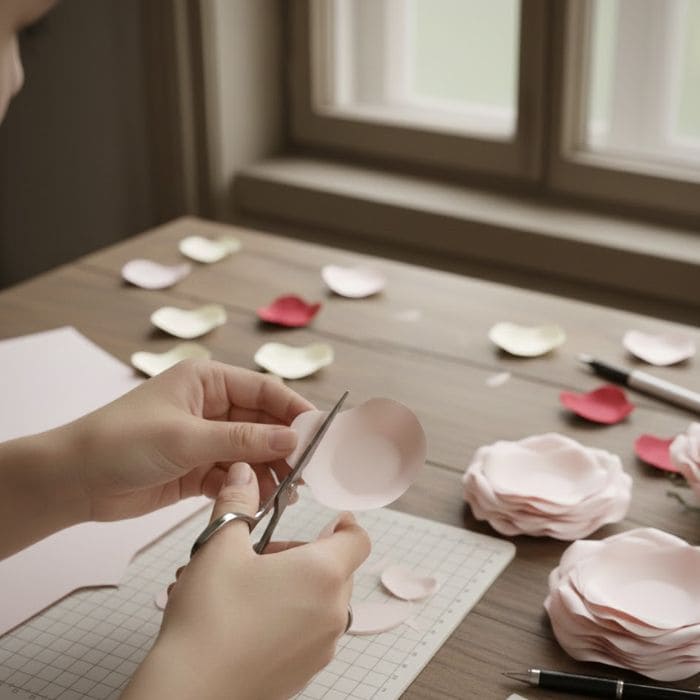
I cut petals in a few sizes, because roses don’t open all at once. The center petals are tighter and smaller, and the outer petals get wider and looser.
I used thicker craft paper so it wouldn’t collapse, and I curled the edges gently with my fingers and the edge of a pen, which instantly makes paper look less flat.
Then I built each rose slowly. I started with a tight center, then I wrapped petals around it one layer at a time, turning the flower as I went so it didn’t lean awkwardly in one direction.
The biggest trick is not trying to make it perfect, because perfection is what makes a handmade flower look fake. Real roses have uneven edges and tiny quirks, so I let mine have them too.
The stems and leaves
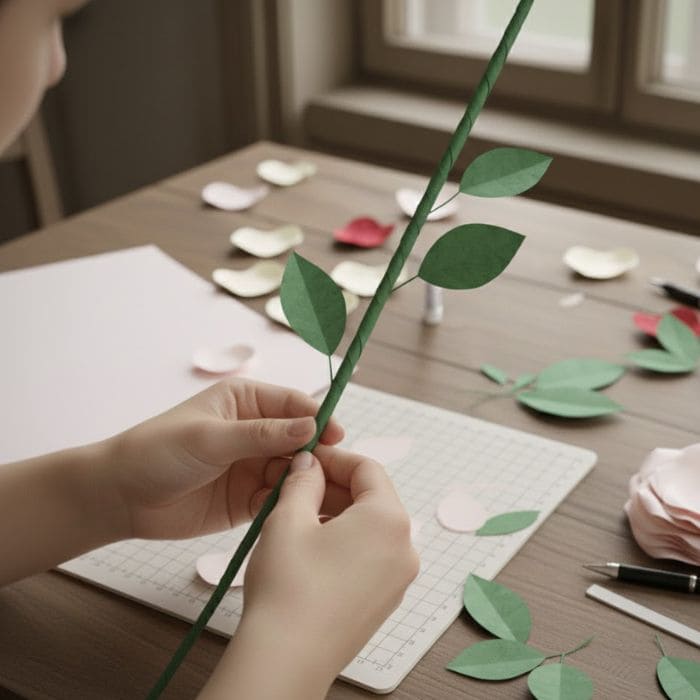
For the stems, I needed them to feel sturdy, not droopy, so I used a firm core and wrapped green paper around it until it looked like a real stem.
Then I added leaves in slightly different sizes, because identical leaves look like a template, and I wanted something that felt more natural.
When I was done, the roses looked good, but they still looked like paper flowers, and that’s when I did the part that changed everything.
The Paint Splatter Trick That Makes Them Look Believable
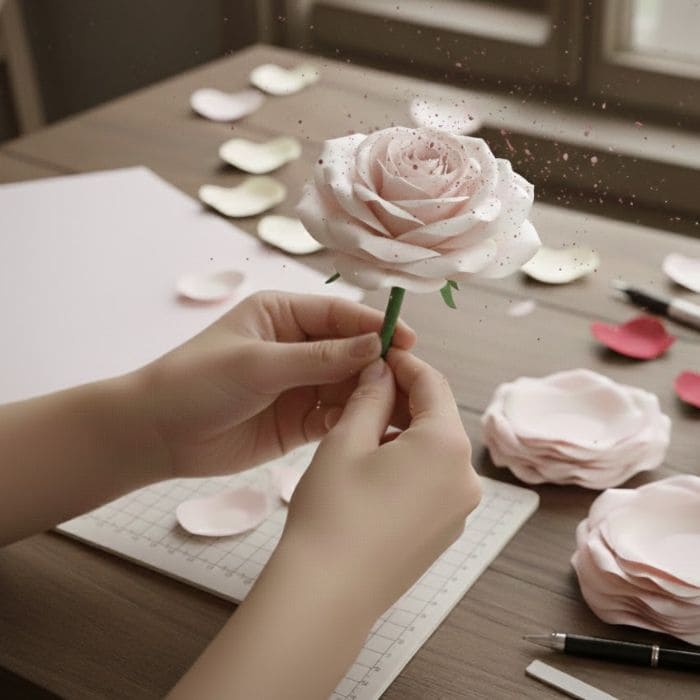
I’m not talking about big paint splashes, more like the lightest dusting, like freckles.
I dipped a brush into a tiny amount of paint, then flicked it gently so tiny specks landed across the petals. I used muted tones, dusty pink, a bit of deeper rose, and a tiny hint of warm brown, because natural petals aren’t flat colored, they have variation and depth.
This step breaks up the paper surface, and once that surface stops looking uniform, your brain starts reading it as something organic. I did the same thing lightly on a few leaves, because leaves have natural imperfections too.
I always tell people to practice on scrap paper first, because the goal is subtle, not chaotic.
The Scent Trick That Makes People Swear They’re Real
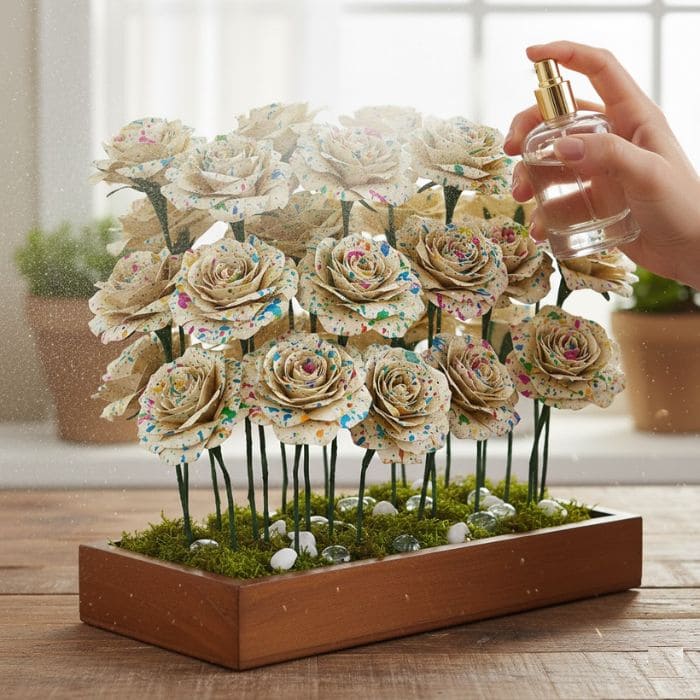
I spray perfume on the tray. Not every day, not in a dramatic way, just a light mist, usually a rose scent, and I do it from a distance so it settles gently instead of soaking the paper.
The paper holds scent surprisingly well because all the folds and layers trap it, and the result is this soft rose smell that drifts through the room when someone walks by.
The first time I tried it, I expected it to smell nice for about ten minutes, and then disappear. Instead, it lingered, quietly, for days, and now it’s part of my little home ritual.
How I keep it from becoming overpowering
I spray once or twice, then I walk away. That’s it. If I can smell it strongly from across the room, I sprayed too much. I want you to notice it when you lean in, not when you taste roses in the air.
I also keep it out of reach of my dog, because pets can be sensitive to fragrance, and I’m not interested in turning a cute decor moment into a headache for him.
Where I Place It So It Works Like a Welcome
I keep the tray in a spot where people naturally pass by, like a console table or a side table near the living room, and not right beside the stove or a heater vent, because heat makes scent fade faster and can make the fragrance feel too intense in a small space.
In that spot, it becomes part of the welcome. It’s not a big centerpiece that demands attention, it’s a quiet surprise that people discover, and those are always the best home details.
If roses aren’t your thing, you can do the same idea with paper eucalyptus, peonies, or even simple wildflowers, and use a matching scent, like clean linen, soft citrus, or vanilla.
You can also tuck a small cotton pad under the flowers and spray that instead of spraying the paper directly, which keeps the scent longer and protects the petals if you’re worried about discoloration.
You can even make it seasonal, roses in spring, citrus in summer, cinnamon in fall, pine in winter, and suddenly your home has a little tradition that doesn’t cost much.