Yesterday, I finished an artwork that made me stand in my hallway for an embarrassingly long time, just staring at it like I couldn’t fully believe it was finally done.
The funny thing is that this piece didn’t begin yesterday. It began years ago, quietly, coin by coin, the way small habits become collections without asking permission.
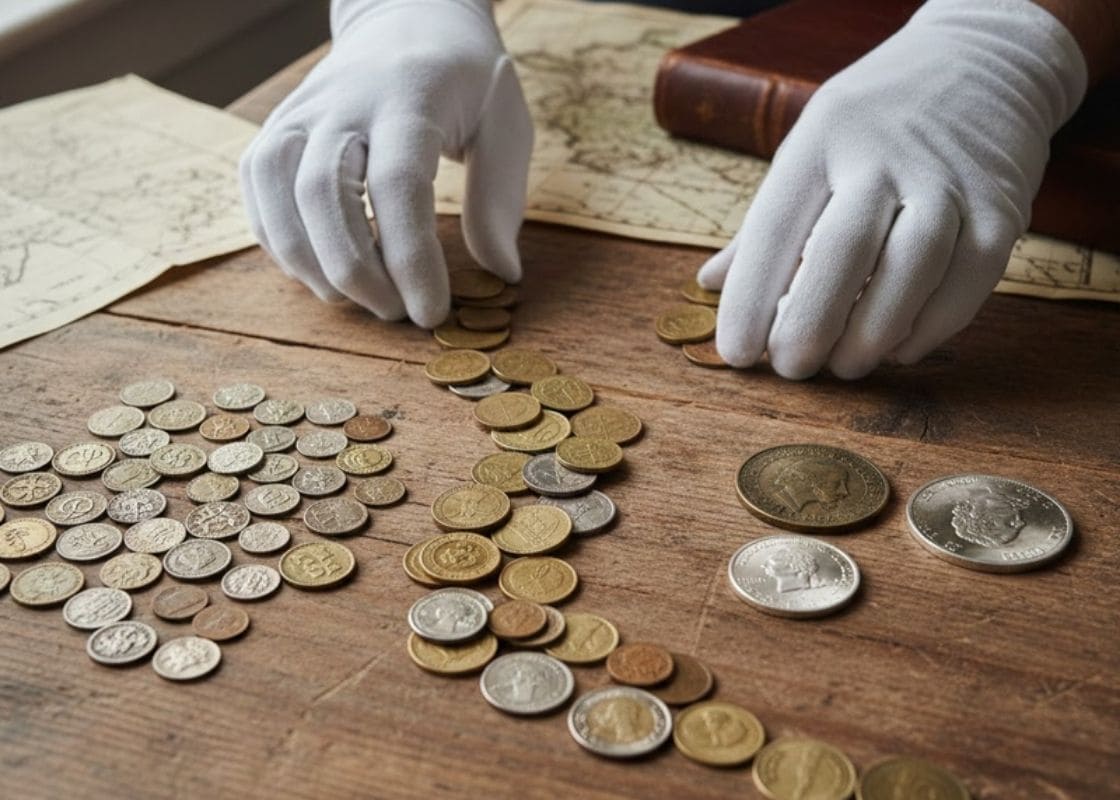
I’ve collected coins for so long that it stopped feeling like a hobby and started feeling like a private language I carried in my pockets. A coin from a train station, a bakery, a museum gift shop, a night when I bought something small just because I wanted to remember the place by touch and weight, not only by photos.
Over the years, I ended up with more than 1,000 coins from Europe, and until recently, they lived in jars and tins and little boxes that made sense only to me.
How the Coin Collection Started, and Why It Grew So Big
I still remember being in Paris, buying something simple and warm from a small shop, and getting change that looked different than the coins at home.
I held them for a second longer than necessary, noticing the edges and the tiny design details, and I thought, this is the most everyday souvenir in the world.
After that, I began saving coins from every European trip, and not only euros. I kept coins from countries that still had their own currency, and I kept older coins too, the ones you stumble across in flea markets.
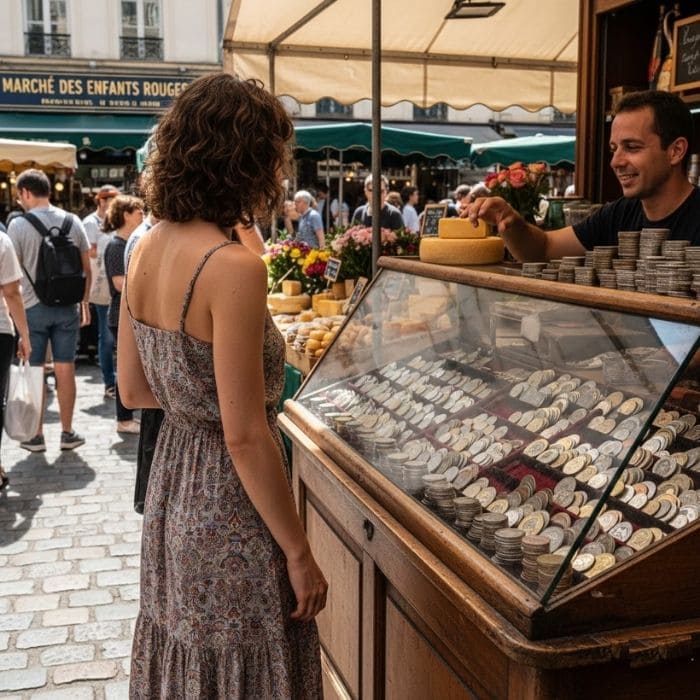
Gradually, my coin mix became this little map of places and seasons:
I have France, and even some older French franc pieces that came from a market table where the vendor told me they were small history in your palm. I have Italy, including some pre-euro coins like lira, and I remember buying them from a box of odds and ends in a stall that smelled like leather and dust and oranges.
I have Spain and a few older peseta coins that I didn’t even mean to start collecting, but once you hold one, you can’t pretend it doesn’t have personality.
I have Germany, and the German coins always make me think of efficient train platforms and hot coffee in paper cups on cold mornings, and I also have some older deutsche mark pieces that feel heavier than they should.
I have The Netherlands, where I remember the way light hits the canals, and I ended up with a handful of older coins along with euros because someone at a shop counter noticed my curiosity and smiled like they understood exactly what I was doing.
I have coins from Belgium, Austria, Czech Republic, Hungary, Poland, Switzerland, Sweden, Denmark, Norway, Ireland, and Greece, and each one pulls up a different kind of memory.
The Artwork Idea That Finally Clicked
I tried a few ideas over the years. I thought about shadow boxes, and I thought about arranging coins in glass jars on shelves, but everything felt either too busy or too hidden. I didn’t want the coins to look like stuff.
The concept that worked was a wall hanger: something with a strong backing, a defined border, and a clean repeating pattern that makes the chaos of 1,000 different coins feel calm and organized.
The Planning That Saved Me From Ruining It
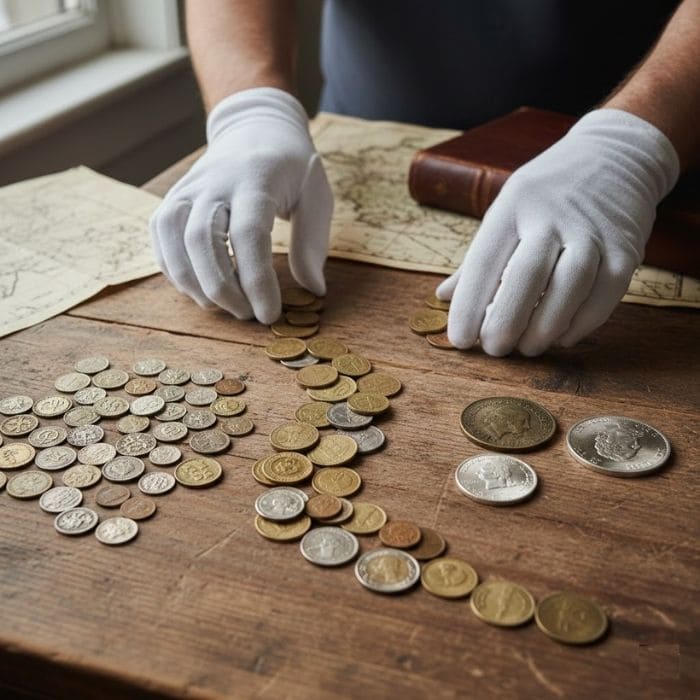
I sorted by size first, because nothing makes a coin layout look messy faster than random sizes placed next to each other without intention. Then I sorted by tone, because coins have their own color families even when they’re all silver or gold, and that matters when you’re using them like mosaic tiles.
I ended up with three broad groups:
- The smaller coins that create fine texture.
- The medium coins that create rhythm and repetition.
- The larger coins that can be used like anchors or focal points.
What I Made, Specifically
My wall hanger is a tall rectangle, roughly the height of a full-length mirror panel but narrower, so it feels sculptural rather than bulky. The backing is rigid and flat, and the edges are framed so the piece looks finished from every angle, not like a craft board pretending to be art.
The coins are arranged in a pattern that reads as intentional from far away, but becomes more personal when you stand close and see the tiny differences: the faces, the symbols, the dates, the countries.
From across the room it looks like texture and shimmer. Up close it becomes a story.
I designed it so the center is the most detailed zone, with a mix of coin sizes and a few older coins that stand out, while the edges are more uniform to keep the eye contained.
My Build Process
First I cleaned the coins lightly, not aggressively. I didn’t want them polished into something unnatural, because I like the patina and the slight wear that makes them feel lived. I wiped them and let them dry fully, and I removed anything sticky or grimy, because glue and dirt is a bad combination.
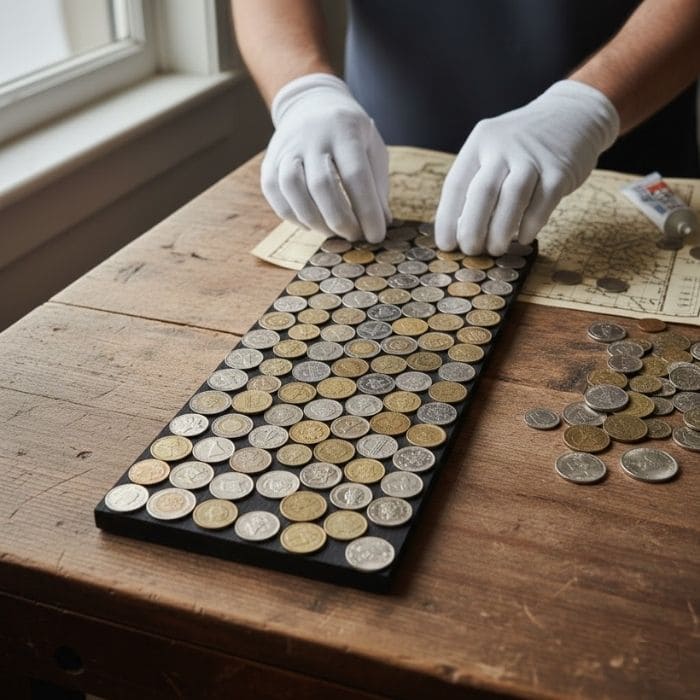
Then I laid out a dry design, meaning I arranged coins on the backing without attaching them. This took time, and it was worth every minute, because it let me spot awkward gaps and repeating clusters before they became permanent mistakes.
Once the layout felt balanced, I began attaching coins in sections, working from the center outward so the design stayed symmetrical and stable.
I kept the spacing consistent, and I pressed each coin firmly so it seated flat, because uneven coins can create tiny shadows that look messy in certain light.
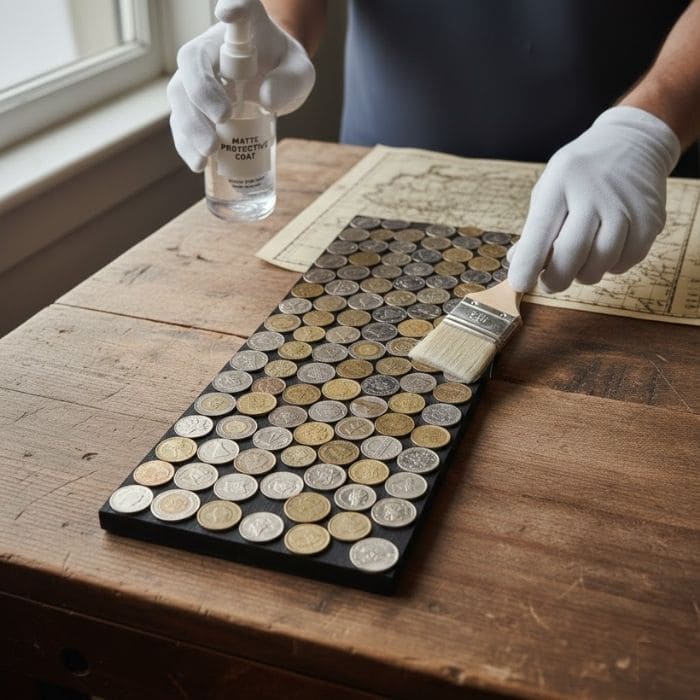
When everything was attached, I sealed the surface, not to make it glossy, but to protect it from fingerprints and humidity, because metal art in a home still lives in a real environment with real air.
Finally, I added strong hanging hardware, because the truth is that a thousand coins has weight, and I refused to turn this into an art fell off the wall story. I tested the hanger gently before committing it to its final spot.
Where I Hung It
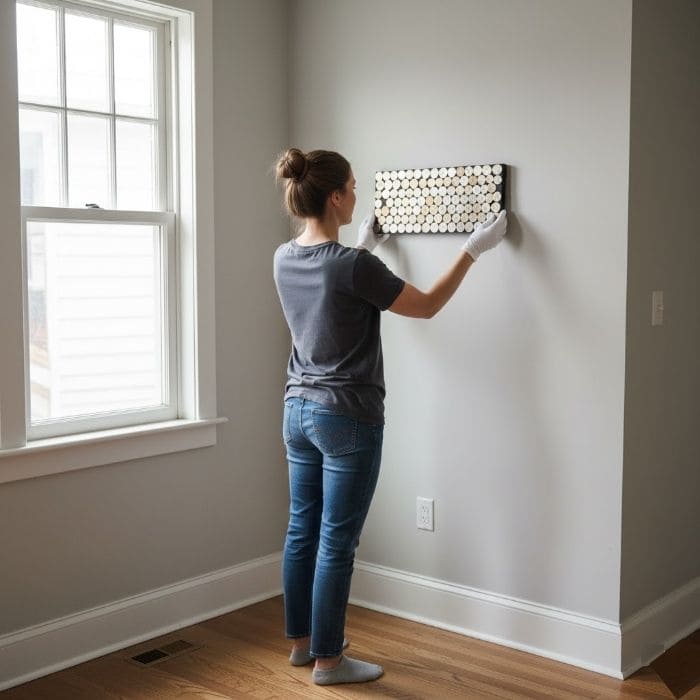
I hung it in on the wall near my window where it gets natural light for part of the day, because coins are beautiful in shifting light. In the morning, it looks subtle and matte. In late afternoon, it catches warmth and becomes almost golden, even when many of the coins are silver toned.
Care Tips and Notes, Especially if You Want One to Last
If you ever want to make something similar, the biggest care rule is simple: keep moisture away and handle it like real art, not like a craft project.
I don’t hang it in a bathroom or above a humid heat source. I dust it gently rather than wiping it with anything wet. If a coin ever looks dull, I leave it, because dullness is part of the story, and I like that the piece looks like it has lived.
One more note that matters: I did not use rare or valuable coins for this. If you have coins that might be collectible or historically important, it’s worth separating those and keeping them safe, because art is wonderful, but regret is not.