Boston gave me one of those rare, gentle days today, the kind that makes you forget you’ve been moving through life on autopilot until the light hits your bedroom floor just right and you suddenly feel awake again.
I had plans recently, I’ve been seeing friends, I’ve been doing all the normal things that should add up to feeling fine, and yet I kept coming home with the same flat feeling trailing behind me.
Not sad exactly, just bored, in a way that felt personal, like I’d slowly stopped paying attention to myself.
It showed up in the smallest place: my closet. I’d stand there with perfectly good clothes in front of me and still reach for the same safe outfit, not because it was my favorite, but because it asked nothing of me.
And standing there this morning, with that good weather confidence in my chest for once, I realized I needed one small system that could hand me back a little spark on the days my brain feels tired.
So I decided to build a fashion coordination idea board inside my closet, right where I get dressed, so I can stop relying on mood and memory and start treating getting ready like a quiet form of self-care again.
What a Fashion Coordination Idea Board Actually Is
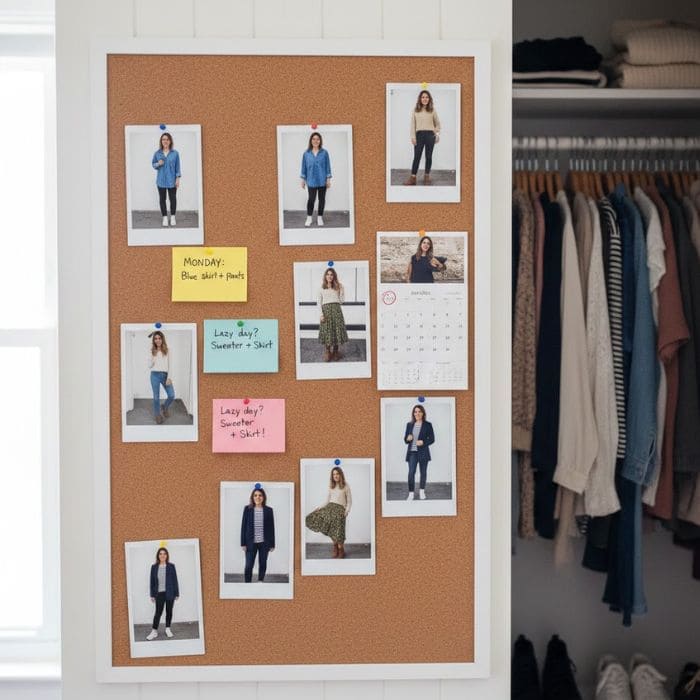
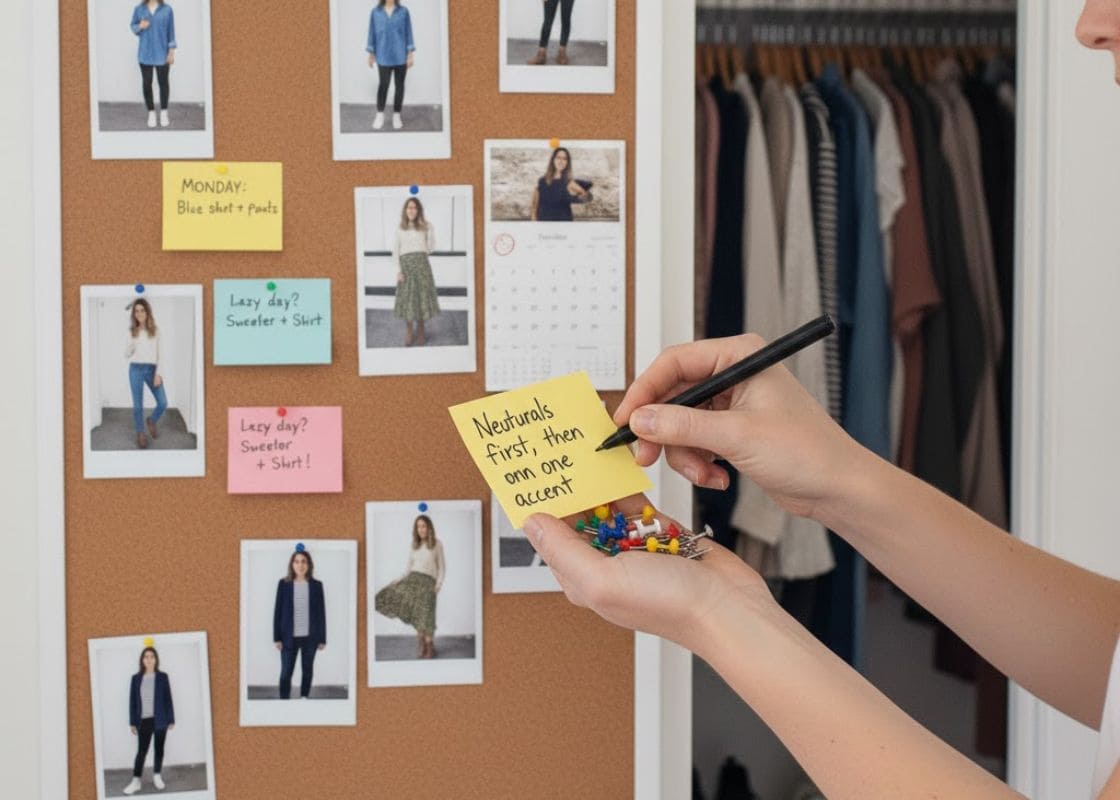
It is a small visual guide that lives where you get dressed. That’s it. Mine is a corkboard inside the closet, and on it I keep a handful of outfit ideas that work with clothes I already own.
I’m not pinning runway photos. I’m not planning outfits that require a new pair of boots or a perfect blazer I do not have. This board is grounded on purpose.
Every outfit idea is something I can put on right now, this week, with what’s already hanging in front of me.
It becomes your shortcut on low-energy days. It becomes your reminder on days you forget what you like.
Where I Put It in the Closet and Why That Matters
I put my board on the inside wall of my closet at eye level, slightly to the right of where I naturally stand.
I did not put it on the door because my closet door swings inward and I know myself. If something shifts, bumps, or looks messy, I stop using it, and then I pretend I never wanted it.
I also wanted it to feel private. Not hidden, just personal. This is not a decoration for guests. It is a tool for me, in the quiet space where I get ready and try to become a person again.
If your closet is small, the back of the door works beautifully, especially if you choose a slim board.
If you rent, you can use removable strips and hooks, but the important part is keeping it light so it stays put, because the last thing you need is a board falling at 7:30 a.m. and ruining your mood for no reason.
What I Used and How I Kept It Simple
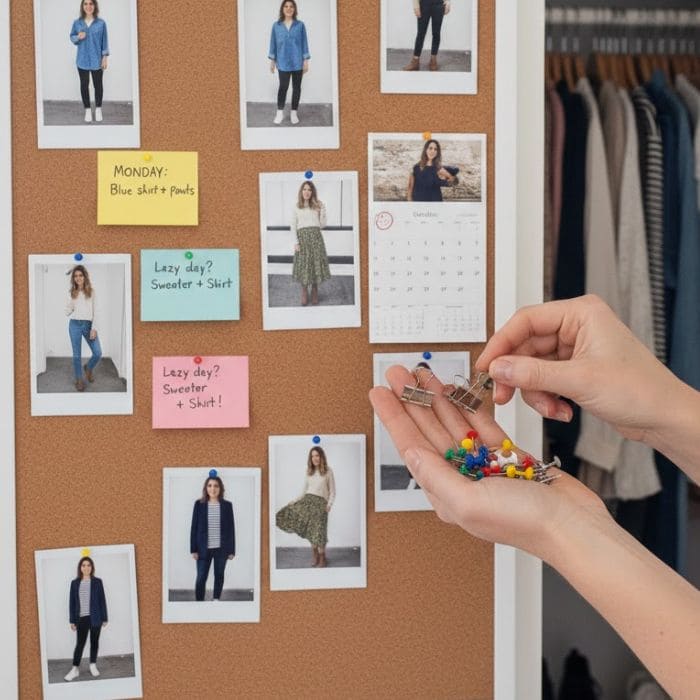
I used a small corkboard that I already had tucked away, a handful of pushpins, and a few mini clips.
If you prefer something neater, a small magnetic board works too, especially if you like swapping ideas quickly without making holes.
The key thing I did that made this feel easy instead of messy was adding one small envelope to the bottom corner of the board.
It holds extra photos, little notes, and outfit cards I am not using right now. It is basically a not today pocket, and it keeps clutter from creeping across the board.
I also attached a pen to the board with a string, which sounds silly until you realize how often you will want to jot something down and then never find a pen when you need it.
The Rule That Kept This From Turning Into Another Abandoned Project
Step 1: I Pulled Out Proof That I Can Look Like Me
I started by looking through my camera roll for days I felt good in my clothes. Not perfect, not styled for a photo, just days where I felt comfortable and like myself.
I found a few, including one outfit from a casual dinner, one from a weekend errand run where I remember feeling oddly put together, and one from a day I wore jeans and a sweater and did not tug at anything the whole time.
Then I recreated two of those outfits and took quick mirror photos in natural light. Nothing fancy. I did not clean the whole room.
Next, I printed them small and pinned them to the board because having them in front of me is different than having them buried in my phone.
When I’m tired, my memory lies to me. The board does not.
Step 2: I Made Outfit “Recipes” Instead of One-Time Looks
This is where it started to feel truly useful. Instead of pinning a specific outfit that only works one way, I wrote outfit formulas that I can repeat with different pieces.
I wrote them on small cards, and I kept them plain so I could glance quickly.
One fitted piece with one relaxed piece. When my top is oversized, I keep the bottom cleaner. When my pants are wide or loose, I choose a more fitted top. That balance alone fixes most of my something feels off moments.
Then I added a few reliable combinations that always make me feel finished without overthinking: a basic tee with a cardigan plus structured jeans, a sweater tucked slightly in the front with straight-leg denim, a simple dress with a third layer like a denim jacket, a button-down worn open over a tank to give shape without feeling tight.
Step 3: I Picked a Color Story Based on My Actual Life
I’m not a strict capsule-wardrobe person, but I do love a simple color story because it stops me from buying random pieces that never match anything, and it stops me from staring at my closet like it’s a puzzle.
So I chose neutrals I already wear and trust, then I chose two accent colors that feel like me right now, in winter, in Boston, in a season where I want warmth without feeling like I’m hiding.
My neutrals are black, cream, denim blue, and soft gray. My accent colors right now are deep green and warm tan, because they make even basic outfits feel intentional, and they pair well with the boots and coats I already own.
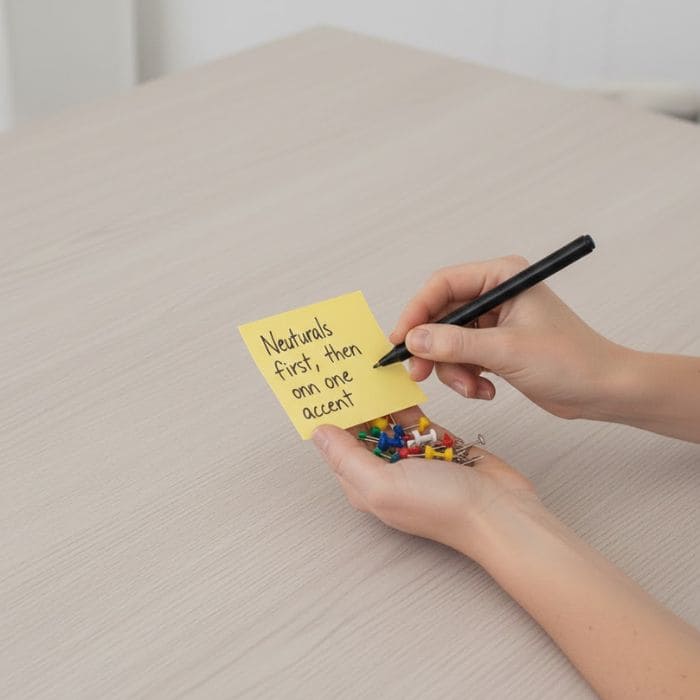
I pinned a little card that says, “Neutrals first, then one accent.” It is simple, but it keeps me from overcomplicating everything when I am low on energy.
Step 4: I Put My Accessories on the Board Because My Brain Won’t Remember
Accessories used to be something I only reached for on days I felt on. I realized that was backwards. Accessories are what make me feel on, so they need to be part of the system, not a bonus.
So I wrote down my defaults and pinned them where I can see them: the earrings that always look intentional, the one necklace that works with almost everything, the belt that fits my most-worn jeans, the bag that does not fight my outfits, the two shoe options that never let me down.
It sounds small, but it removes the last-minute scramble, and it keeps me from walking out the door feeling unfinished and slightly irritated.
Step 5: I Made a “Two-Minute Rescue” Spot for Bad Outfit Mornings
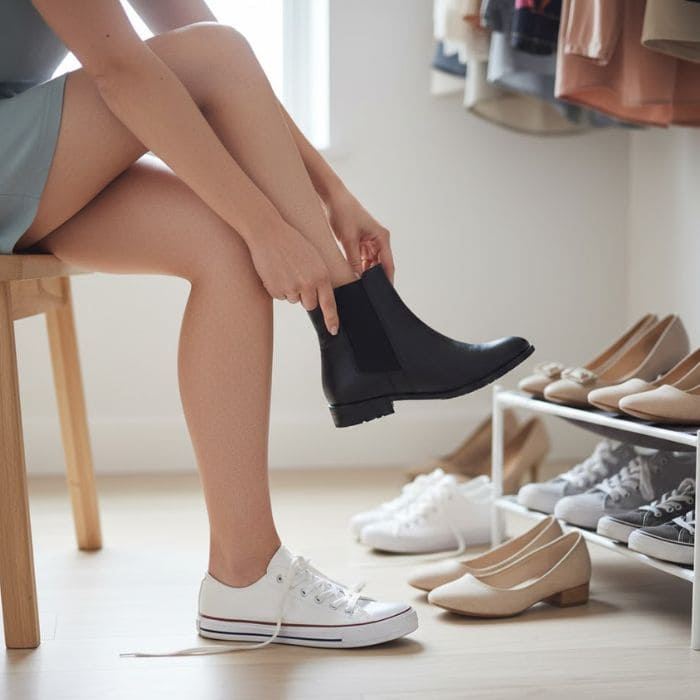
This is my favorite part because it respects reality. Some mornings you put something on and it feels wrong, and the temptation is to rip it all off and start over, which is how you end up late and grumpy.
So I pinned three quick fixes that work almost every time. First, change the shoes. Shoes change the entire tone of an outfit faster than anything else.
Second, add a layer. A cardigan, a jacket, an open button-down, a coat that has structure. A third piece gives shape and makes you look finished even when the outfit underneath is simple.
Third, swap only one item. Not the whole outfit. If something is wrong, it is usually one piece, and replacing one piece is manageable.
Having those reminders in front of me is like having a calm friend in the closet, which I honestly need more often than I like to admit.
What Changed After I Made It
The surprising part is that the board did not just make outfits easier. It made me feel more present. It gave me a small daily moment that felt like care, not performance.
I realized my boredom was partly the result of repetition without intention. The same outfits, the same choices, the same good enough pattern, over and over, until everything started to feel flat.