When my husband was living, he installed cabinets around our home, the kind that don’t call attention to themselves but quietly make life easier, and I think I appreciate them even more now because they keep working even when I’m tired, even when I’m distracted, even when I don’t have the energy to get organized from scratch.
Today I want to share the cabinet I find most helpful, the one I reach for almost every day without thinking, and it’s the cabinet under my staircase.
It isn’t the prettiest cabinet in the house, and it’s not the one guests comment on, but it is the one that keeps my entry area from turning into a pile of half-finished life.
It sits in that awkward wedge of space under the stairs that many homes leave unused, the place that can easily become a dumping zone because it’s out of sight and shaped strangely, and he looked at it and saw potential instead of inconvenience.
He built it in a way that fits the angle of the stairs, uses the depth without wasting it, and gives me a place for the things that otherwise float around the house and make everything feel slightly messy.
Where the Cabinet Lives and Why That Location Matters
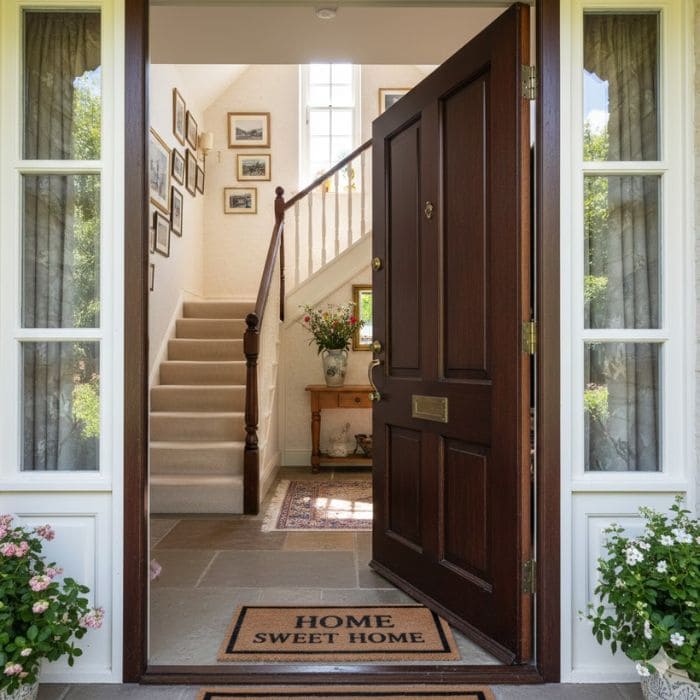
My staircase is near the main hallway, and the under-stair cabinet sits on the side that faces the entry path, which means it’s right in the natural flow of the house. That location is the entire reason it works.
The best storage is the storage you don’t have to walk across the house to use, and under-stair storage is perfect when it catches items right at the point where they enter your home.
This cabinet acts like my home’s quiet buffer. Shoes come in, bags come in, small “where do I put this” items come in, and instead of drifting toward the kitchen counter or a chair that becomes the chair of doom, they have a designated place within a few steps of the door.
The Size and Shape, With Real Numbers
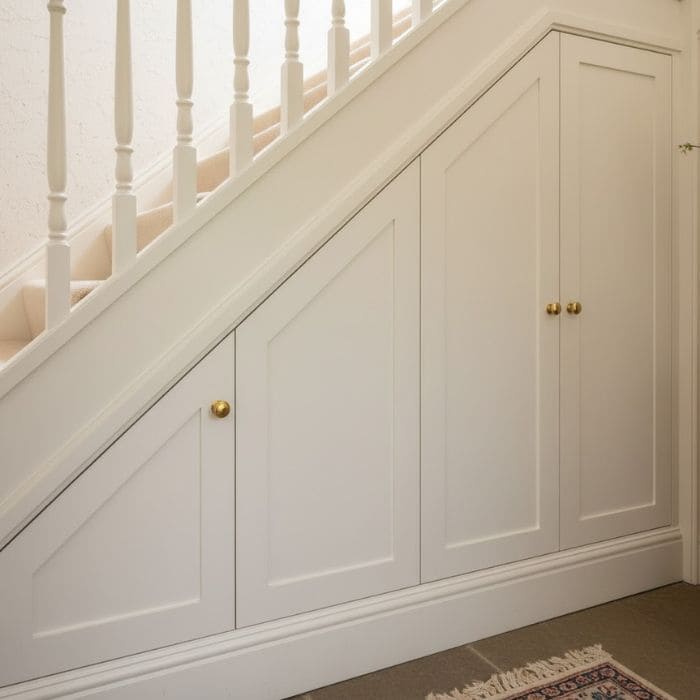
Because it’s under a staircase, the cabinet is not a perfect rectangle, and that’s what makes it so satisfying when it’s done well.
The cabinet spans about 62 inches along the base of the wall, which is a little over 5 feet. The deepest section is about 22 inches, which is enough depth for shoes, small bins, and even a compact vacuum, but not so deep that things disappear into a black hole.
The height at the tallest point is about 48 inches, and it slopes down with the staircase angle toward the lower end.
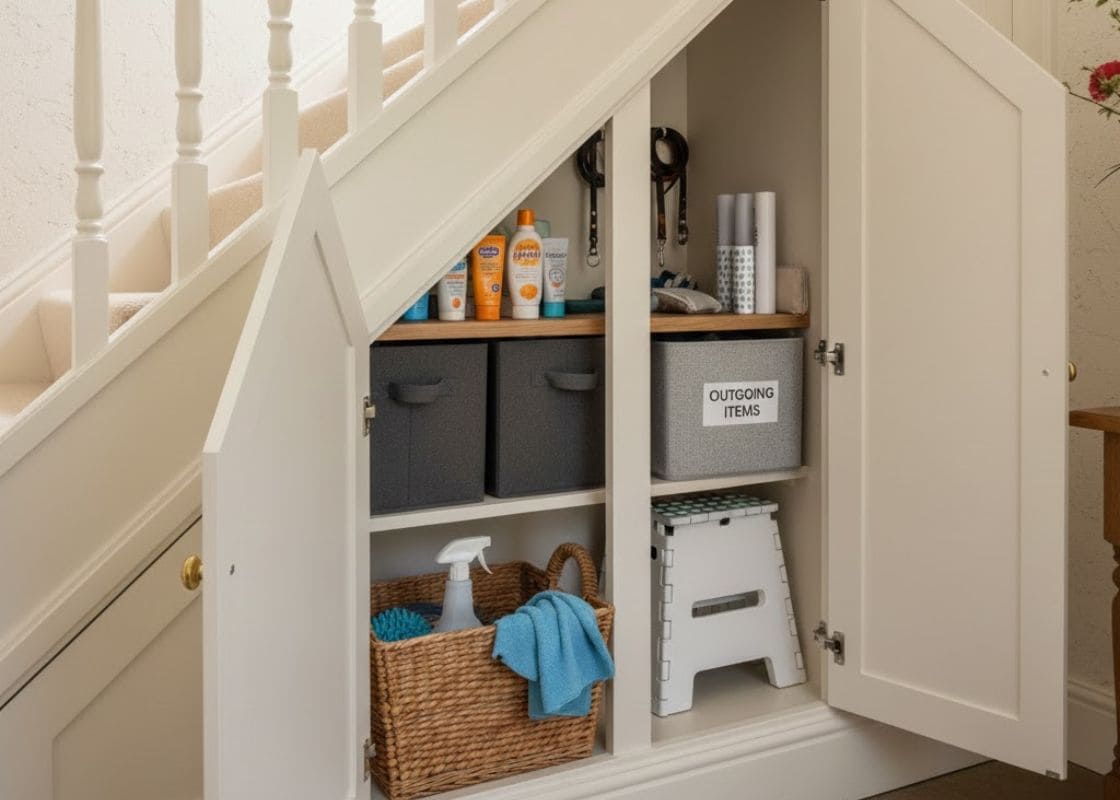
It has two doors with simple knobs, and inside, he built it with one fixed shelf at about 14 inches high, plus a deeper lower section for taller items. That one shelf was a smart choice because it creates two zones instead of one giant cave where everything stacks and collapses.
If you’re planning something similar, those are the dimensions that matter most: how long the usable base is, how deep you can go without losing items, and how you divide the space so it doesn’t become a single messy pile.
What I Store Inside, and Why These Categories Work
The lower section: bulky, grab-and-go items
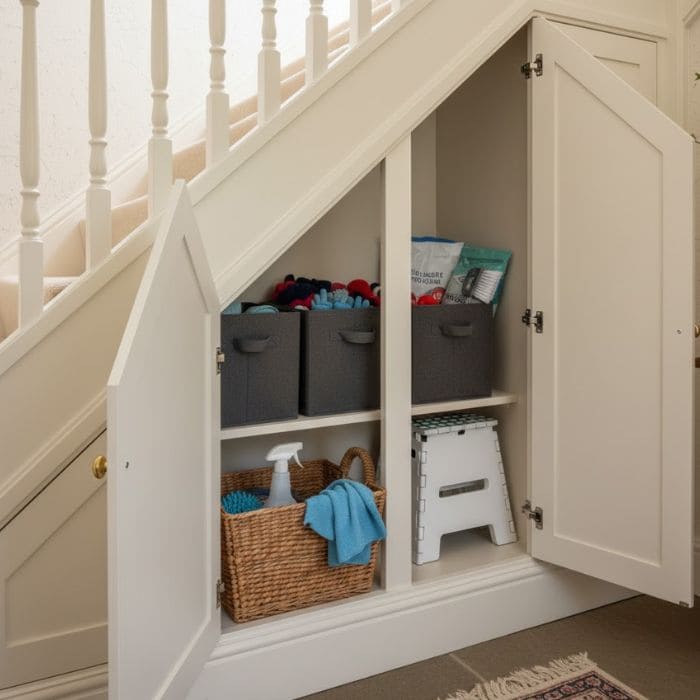
The bottom area holds the items I need quickly and don’t want to wrestle with in a high shelf.
I keep a small cleaning basket with an all-purpose spray, microfiber cloths, and a handheld duster, because when I notice dust or a spill near the entryway, I can handle it right away without walking to another room.
I also keep my small step stool here because it’s the kind of item you need suddenly, and when it’s not stored well, it ends up leaning in a corner.
In winter, this lower section also becomes my Boston weather survival zone. I keep a bin for gloves and hats, and another for ice melt and a small brush, because those are the items you only need at certain times, but when you need them, you need them fast.
The shelf zone: smaller items that get lost easily
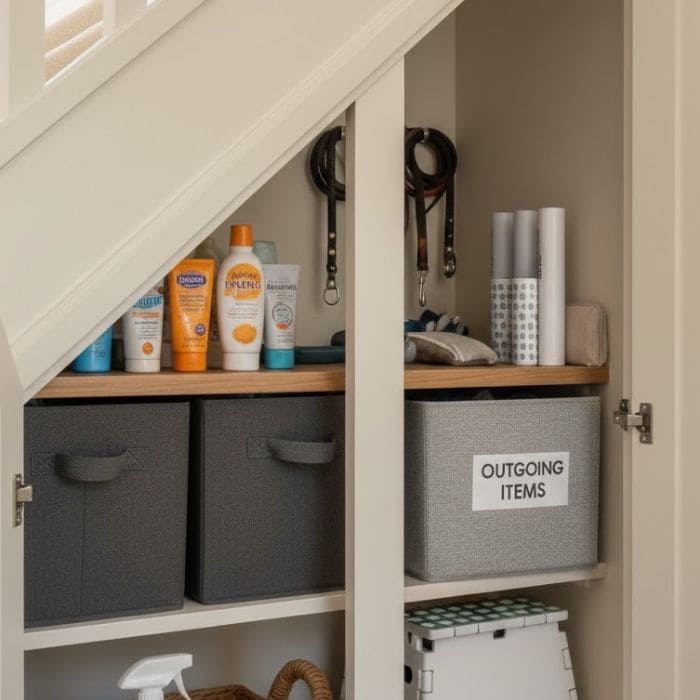
On the shelf, I keep items that tend to drift such as sunscreen in summer, bug spray, spare dog leashes, lint rollers, and a small pouch with batteries and basic home essentials.
I also keep a labeled bin for outgoing items, which has been one of my best habits. If something needs to go back to a friend, be returned, or be taken to donation, it goes in that bin.
The hidden hero: dog supplies
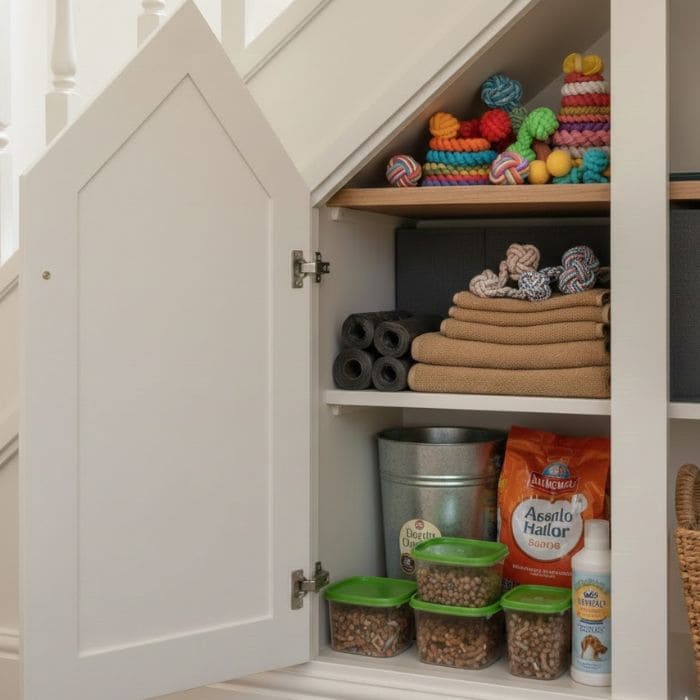
Because my dog follows me everywhere, I store his essentials where I can reach them quickly. I keep extra waste bags, a towel for muddy paws, and a small container of treats.
If you have a pet, under-stair storage is perfect for that kind of daily support, because it keeps the supplies close without making the house feel like a pet store.
The Simple System That Keeps It From Becoming a Junk Cabinet
A cabinet under the stairs can become a clutter trap if you don’t give it rules. My rule is that everything inside needs to belong to one of three categories: leaving the house, coming into the house, or cleaning up the house.
That rule sounds strict, but it’s what keeps this cabinet calm. It keeps me from shoving random things into it just to clear a counter, because counter clutter moved into a cabinet is still clutter, it’s just hidden clutter.
I also do a quick reset once a week, usually on Sunday evening. I open the doors, put anything back in its bin, toss anything that doesn’t belong, and wipe the shelf if it needs it. It takes five minutes, and it keeps the cabinet from turning into a problem.
Advice If You Want to Build or Improve Under-Stair Storage
If you already have an under-stair space and you’re thinking about turning it into storage, here’s what I would tell you based on what I’ve learned from living with this cabinet.
First, treat depth carefully. Deep storage is tempting, but if the cabinet is too deep, you’ll lose items and stop using it. If you can, build it with pull-out drawers or sliding bins, because pull-outs make deep spaces usable.
Second, divide the space. Even one shelf helps, but two zones are always better than one. When everything stacks into a single cavity, it becomes a mess fast.
Third, put it in the path of life. Under-stair storage works best when it’s near where shoes, bags, coats, dog gear, and daily routines happen. If it’s tucked away far from your entry area, it won’t get used consistently.
Fourth, label bins lightly. You don’t need a whole label maker moment. A small tag that says “winter,” “dog,” “outgoing,” or “cleaning” is enough to keep you from dumping.